
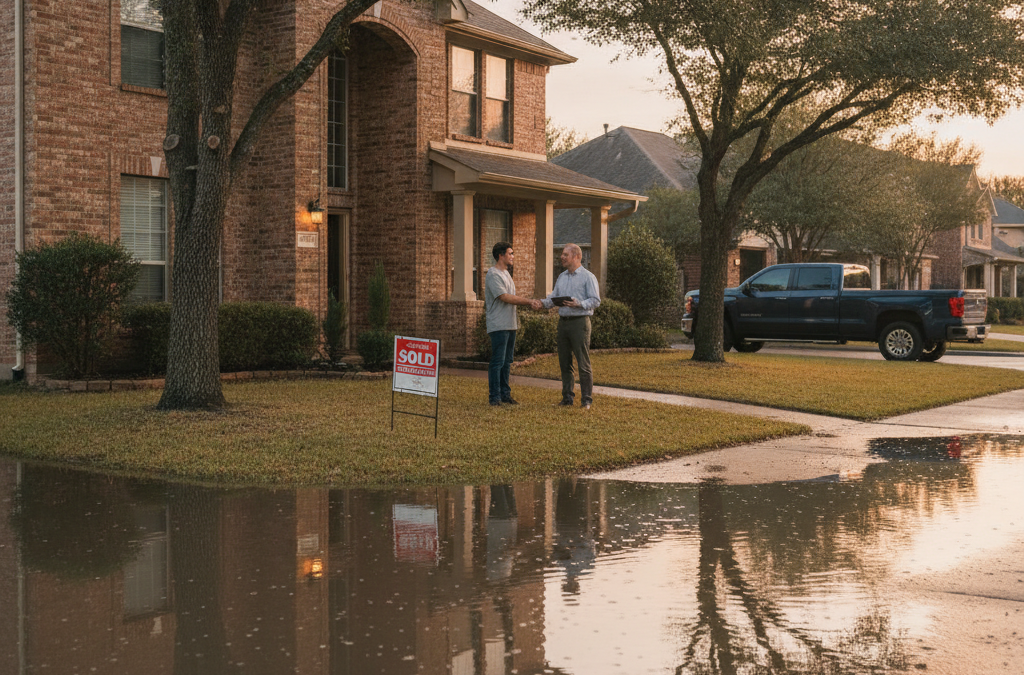
How to Sell a House in Houston When Your Property Is in a Flood Zone
Yes, you can sell a house in a Houston flood zone — but if you plan to list it on the open market, you’re going to run into a set of obstacles that most sellers don’t fully see coming. Lenders get nervous. Buyers hesitate. Insurance quotes come in high. And the disclosure requirements in Texas are more detailed than many homeowners realize. If your property sits in a FEMA-designated Special Flood Hazard Area, or if it has flooded before even without an official designation, this guide will walk you through exactly what that means for your sale — and how to get out from under it without a drawn-out, uncertain process.
Why Flood Zone Properties Are So Common in Houston — And So Hard to Sell Traditionally
Greater Houston isn’t just flood-prone — it’s one of the most flood-exposed metro areas in the entire country. The geography doesn’t help: flat terrain, clay soil that doesn’t absorb water well, and a sprawling network of bayous that overflow during heavy rainfall. Harris County alone has more federally declared flood disasters than any other county in the United States. If you live near Brays Bayou, White Oak Bayou, Greens Bayou, or any number of smaller tributaries, your property may be on or near a FEMA flood map zone — even if your neighbors just a few blocks away are not.
Communities like Humble, Pasadena, and Baytown have seen entire subdivisions inundated multiple times since 2015. Parts of Pearland and Missouri City near Sims Bayou and Willow Fork have similar risk profiles. Galveston County and Brazoria County properties near the Gulf Coast carry their own layers of exposure. The result is a large pool of Houston-area homeowners who own properties that are genuinely difficult to move through traditional real estate channels — not because there’s anything wrong with the house itself, but because of where it sits on a map.
What Flood Zone Designation Actually Does to Your Sale
When a buyer applies for a conventional mortgage or an FHA loan on a property in a FEMA Zone A or Zone AE — both high-risk designations — their lender will require flood insurance as a condition of the loan. That’s not optional, and it’s not cheap. In some Houston zip codes, flood insurance through the National Flood Insurance Program (NFIP) can run anywhere from a few hundred dollars a year to well over $3,000 annually depending on the property’s elevation, prior claims history, and the specific zone. Private flood insurance is available but adds another layer of complexity to underwriting.
Here’s what that means in practice: a buyer who falls in love with your home may get to the insurance quote stage, see a number they didn’t budget for, and walk away. Or their lender may require an elevation certificate — a survey document showing how your home’s lowest floor compares to the Base Flood Elevation — before they’ll approve the loan at all. If you don’t have one, that’s another cost and delay added to the process. And if the elevation certificate shows your home is below BFE, the insurance cost goes up further.
None of this is impossible to navigate. But it does mean that selling a flood zone home through a traditional listing is slower, more uncertain, and more likely to result in a deal falling through at the last minute — sometimes after weeks of waiting.
Texas Flood Disclosure: What You’re Required to Tell Buyers
Texas law is specific on this point, and it has gotten stricter in recent years following Hurricane Harvey and other major flood events. As a seller, you are required to disclose in writing whether the property is located in a FEMA-designated flood zone, whether it has flooded before (from any source, not just a named storm), whether it has received flood damage insurance proceeds, and whether any flood mitigation work has been done. This information goes on the Texas Seller’s Disclosure Notice.
Failing to disclose known flood history isn’t just unethical — it exposes you to serious legal liability after the sale. Most sellers do the right thing and disclose fully, but that disclosure then becomes a negotiating point. Buyers use it to ask for price reductions, repair credits, or both. In a market where flood-zone homes already face limited buyer pools, a prior flooding disclosure can make the process significantly harder.
If you’d rather not spend months negotiating over your flood history while carrying insurance, property taxes, and maintenance costs on a house you’re trying to leave, a direct cash sale sidesteps most of this friction entirely. Here’s how our process works — it’s straightforward and built for exactly this kind of situation.
What a Cash Buyer Does Differently With Flood Zone Homes
When you sell to a local cash buyer like Hero Homebuyers Houston, the financing contingency disappears — because there is no financing. That means no lender requiring flood insurance as a condition of closing. No elevation certificate delays. No underwriting department getting cold feet because of your property’s FEMA designation.
We buy flood zone properties in Harris County and surrounding areas in their current condition. If your home flooded during Harvey or Imelda and was repaired — or even if it wasn’t fully repaired — that doesn’t disqualify it. We assess the property as it stands, make you a straightforward cash offer, and let you pick the closing date. Most closings happen within seven to fourteen days. You pay no commissions, no closing costs, and you don’t need to fix anything or clean anything out before you leave.
This matters especially for homeowners who have already relocated, are tired of paying flood insurance on a home they no longer want, or are watching their NFIP premiums climb each renewal cycle with no end in sight. For those situations, a fast, certain cash sale is often worth more in real terms than a higher list price that may never actually close.
A Gap Most Competitors Ignore: Elevation Certificates and What to Do If You Don’t Have One
Here’s something that almost no local competitor covers well: what to do if you’re in a flood zone and you don’t have an elevation certificate — and you can’t afford to wait for one or pay for one out of pocket right now.
If you’re listing on the MLS, many buyers’ lenders will require this document before they’ll fund the loan. Getting one typically costs between $500 and $800 from a licensed surveyor, and it takes time to schedule. If your home was built before your municipality adopted its current flood maps (a common situation in older parts of Houston and Pasadena), you may also be eligible for a Letter of Map Amendment — a FEMA process that can remove your property from a flood zone designation entirely. But that process takes months and requires its own documentation.
With a cash buyer, none of that is a prerequisite. We don’t need your elevation certificate to close. We evaluate the property ourselves and price our offer accordingly. If you know your home’s flood zone status and history, that’s enough for us to move forward. Request your free cash offer here and we’ll take it from there.
Frequently Asked Questions: Selling a Houston Flood Zone Home
Does being in a flood zone mean I’ll get a low offer from a cash buyer?
Not automatically. Cash buyers factor in flood zone designation along with the home’s condition, location, comparable sales, and flood history. A well-maintained home in a Zone X (minimal risk) or a Zone AE with no prior claims may still receive a strong offer. The key is transparency — share what you know, and a reputable buyer will give you a fair, honest number.
Do I have to disclose flooding history if I sell to a cash buyer?
Yes. Texas disclosure law applies regardless of who you sell to. Any known flood history, flood insurance claims, or flood zone designation should be disclosed in writing. A trustworthy cash buyer will not be deterred by disclosure — they already factor these things into their assessment.
Can I sell my Houston home if it has a current flood insurance claim open?
In most cases, yes — but it requires coordination. If there’s an active NFIP claim, the proceeds may need to be handled carefully at closing, especially if there’s a mortgage lender involved. This is a situation where working with a buyer who has local experience in Harris County flood transactions really matters.
What if my home flooded but was never officially reported?
Texas law still requires you to disclose it if you know about it. “Not reported” doesn’t mean “not disclosed.” Many Houston homeowners pumped out and dried their homes after Harvey without filing insurance claims — that still needs to be on the seller’s disclosure. A cash buyer who understands the Houston market won’t use this against you unfairly.
Are there neighborhoods in Houston that are no longer flood zones after Harris County mitigation projects?
Yes. Harris County Flood Control District has completed or is actively working on major channel improvements and buyout programs in several corridors. Some properties near Brays Bayou and White Oak Bayou have had their flood zone designations updated. If you think your property may have been reclassified, check the current FEMA Flood Map Service Center or consult a local surveyor — but keep in mind this process takes time if the maps haven’t been officially updated yet.
Ready to Move Forward? Let’s Talk.
Owning a home in a Houston flood zone doesn’t have to mean being stuck. If you’re tired of the insurance bills, the uncertainty about what a future storm might bring, or simply the difficulty of selling a property that traditional buyers keep walking away from — there’s a simpler option. Hero Homebuyers Houston buys flood zone homes across Harris County and the surrounding area, in any condition, with no repairs, no commissions, and no pressure. We close on your schedule and cover the costs.
You don’t need to figure out the elevation certificate, the NFIP paperwork, or how to position the home for a nervous buyer pool. We’ve already done that work. Reach out today for a free, no-obligation cash offer and find out what your flood zone property is actually worth to a buyer who’s ready to close.